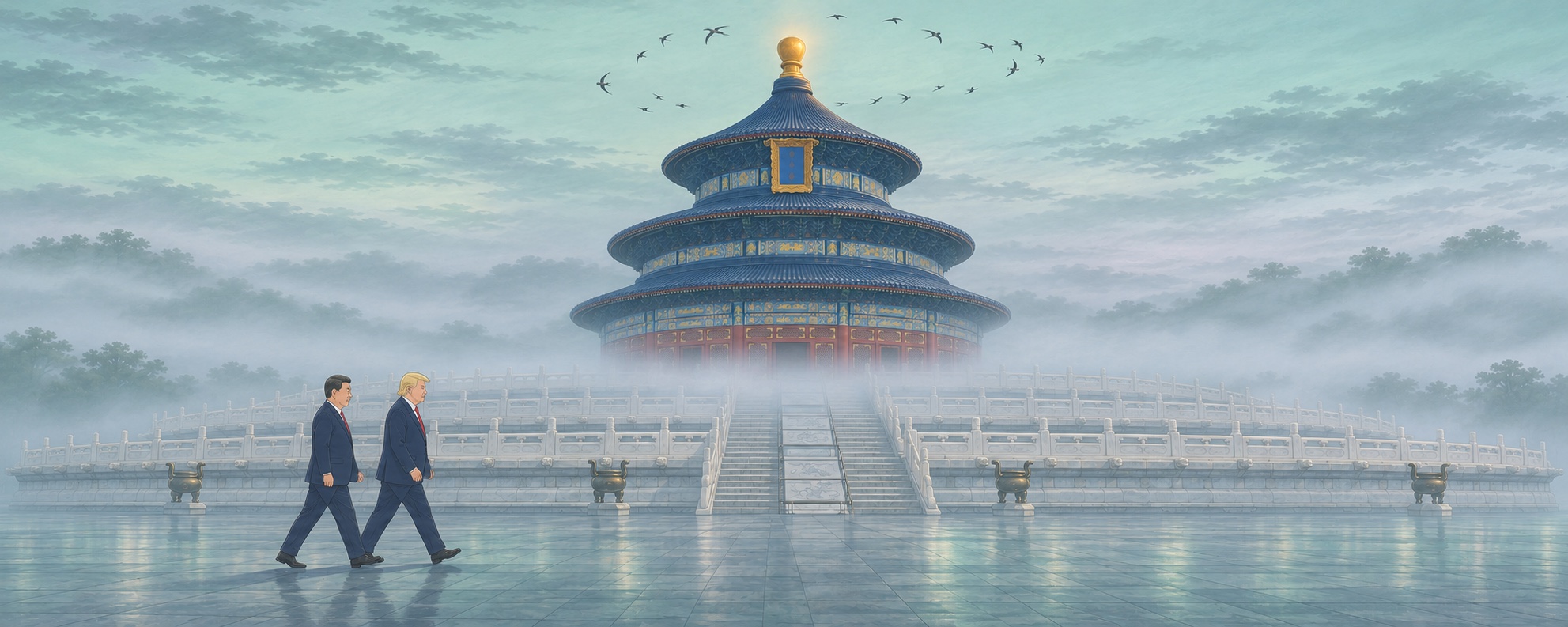
Part of my notes on the Trump-Xi Beijing Summit.
During the Xi-Trump Beijing Summit 2026, President Xi closed the Temple of Heaven for the visit. It's far less known in the West than the Forbidden City, but if you ever go to Beijing, it's a must-visit. Looking at the footage and photographs, I was struck by how stunning it is: the rooflines, the wood sculptures, the detail. I visited as a child, but I don't think I truly saw it then.
I hope Western media takes this moment as an invitation to go deeper, not just into the optics of the visit, but into what the Temple of Heaven actually represents philosophically. Because this is where the conversation about China usually goes wrong. Western commentary tends to call China an atheist nation. Modern China is officially secular, yes. But atheist in its philosophical foundations? Not quite. And on the other side, we have to be honest that America is fundamentally a Christianity-shaped civilization. When you have that difference at the table and you don't understand it, you will keep misreading each other.
Modern China is officially secular, yes. But atheist in its philosophical foundations? Not quite.
So what does the Temple of Heaven represent? It's the physical embodiment of the Mandate of Heaven, Zhi TianMing (知天命) in Chinese. And this concept is profoundly different from the redemption-based structure of most Western religions. In Christianity, and in many other faiths, there's a fundamental premise: you are born sinful, and through faith you earn a chance at redemption. There is a linear arc: a beginning, a fall, a salvation, an apocalypse, a second coming. History moves in a line toward an end.
The Mandate of Heaven works differently. The orthodox Chinese philosophical view is that your destiny is already woven into the fabric of the universe. There is no original sin to overcome, no redemption to be earned. And crucially, there is no apocalypse. No end of the world. Chinese Time is not a line moving toward a conclusion. Chinese Time is a cycle. Dynasties rise and fall. Powers ascend and recede. The wheel turns.
And if you understand that, suddenly a lot of Chinese behavior makes more sense to Western eyes. For example, this is why most Chinese people I know are genuinely not excited about being officially designated G2, number two in the world. And many are equally uncomfortable with the idea of being number one. It's not false modesty. It's a philosophical disposition rooted in cyclical thinking: being at the top means you are closest to the moment of decline. There are enormous costs to maintaining that position. Standing out is a cautionary tale, and caution is wisdom.
So when you hear analysts ask why China isn't more aggressive about claiming global dominance, the Mandate of Heaven is part of the answer. Chinese people are not living toward a finale. They believe life is about managing the cycle.