
I went off script on Taipology. Below are my overall read on the summit and the talking points I didn't get to.
The Overarching Item
Most post-summit commentary is focused on counting which items on the agenda bore fruit and which didn't. My overall read is different. I had this hunch before the summit happened, and it's held up after: there was really only one overarching item on the table. Actually, one item in a pair of two conflict zones: Taiwan and Iran.
Start with Taiwan. Notice that China was the host of the summit, yet the White House announced it first. China didn't officially confirm it until practically the moment President Trump was boarding Air Force One. My read: China would not fully greenlight this summit until a minimum consensus had been reached on one critical issue, and that has to be Taiwan. Specifically, China is likely asking that the US acknowledge Taiwan's reunification with China is non-negotiable. I know that lands hard for some people. But that's my read. Once that minimum consensus was in place, the summit got its full greenlight. Everything else (market openings, trade negotiations) was a starter. Important, but secondary. And with three more Trump-Xi meetings reportedly planned this year, those negotiations can wait.
And on Iran: Iranian Foreign Minister Abbas Araghchi was invited (not self-initiated, invited) to Beijing right before President Trump arrived. That sequencing is deliberate. My read: Iran was very much in the room during the Trump-Xi summit, and Beijing was giving Tehran assurance that its bottom lines would be protected. This is consistent with China's later stated positions on the Strait of Hormuz.
And after the summit, Secretary of State Rubio commented that the US agrees the Taiwan issue should be handled peacefully (I'm paraphrasing). And President Trump himself said Taiwan is nine thousand miles away, too far to get involved. I think those statements give my read some merit.
That said, I do think there were a number of very interesting signals coming out of this summit (before, during and in the aftermath) that I found worth paying attention to.
Debunking Xi's Thucydides' Trap
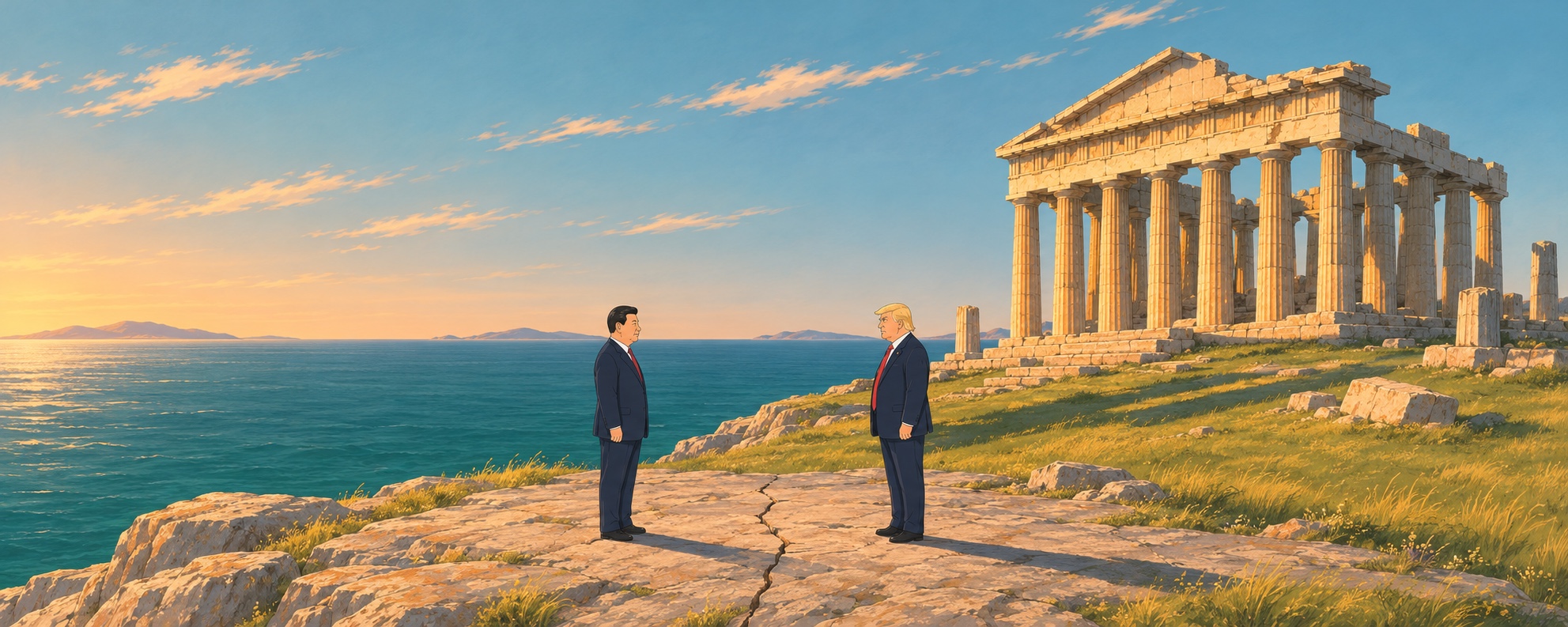
Probably the most interesting moment of the entire summit, to me at least, was President Xi quoting Thucydides' Trap. I was genuinely surprised, because it's a well-debated term even in the West. And when he quoted it, it was immediately misread, triggering a direct response from President Trump. The misread: that Xi was calling America a declining nation. I think that's a significant misreading.
For those unfamiliar: Thucydides' Trap goes back 2,500 years, to the Greek historian Thucydides and his account of the Peloponnesian War. His observation: when a rising power challenges a ruling power, war becomes almost inevitable. In the original, Athens was the rising sea power; Sparta was the dominant land power. The tension between them eventually consumed both.
But let's look at who's actually playing which role of Athens and Sparta today. The US is the quintessential supreme sea power, the hegemon of naval dominance since World War II. China, despite its coastline, is fundamentally a land power, constrained by the postwar order, the first island chain and so on. Historically the land power, like Sparta, tends to hoard resources, maintain hierarchy and defend the existing order. The sea power, like Athens, tends to favor free trade, openness, exchange, creativity, etc.
But now ask yourself: who is currently promoting blockades and restrictions? And who is promoting free trade and open exchanges? We see the line of Athens and Sparta characteristics interchanging and blurring between the rivalry of China and the US. The roles don't map cleanly onto the original framework anymore.
The term itself was modernized by Harvard professor Graham Allison, who coined "Thucydides' Trap" as a political science concept. Though even in the West, the theory is debated, because history keeps producing exceptions. Spain and Portugal in the late 15th century. Britain and the United States in the early 20th. Even the US and the Soviet Union throughout the Cold War produced only proxy wars, not direct confrontation.
So I think President Xi quoting Thucydides' Trap was far from signaling that America is a declining nation. In Chinese culture, that's simply not how face works. The actual message, at least in my read, is far simpler and more direct: if something looks like a trap, it probably is one. So let's both be careful not to walk into it.
Made With China, Made in America
One of the most interesting things around this summit was a tweet by Laura Ingraham saying Beijing and the Trump team were discussing one trillion dollars of direct investment by China into building American manufacturing plants. That caught many people off guard, for sure. But I think if it ever gets anywhere, it's actually a very smart move. And whoever came up with it, even if it's still a rumor, must be someone with superb realism about geopolitics and the modern world economy.
I actually shot back a tweet to Laura Ingraham's original. It reminded me of a conversation I had about a year ago, right around the peak of the H-1B visa debate. You'll remember: there was enormous pushback, from both Republicans and Democrats, some calling to eliminate H-1B entirely, arguing it was taking American jobs. There's something to that, particularly as the program has seen abuse, with certain demographics capturing a disproportionate share of visas. But let's set that aside.
I was talking with a hardware founder in Silicon Valley, a rare breed who understands software but also hardware, chips, supply chains, all of it. We were joking about the Silicon Valley mantra: software ate the world, manufacturing built it. But on the H-1B visa, he said something that stuck with me. Instead of demolishing the H-1B visa, he proposed, America should shift H-1B quotas from Indian software engineers to Chinese manufacturing engineers. Most Chinese don't even call them engineers; they call them shifu. They are extraordinarily experienced, front-line, factory-floor talent. Plant managers. Highly sophisticated work.
Look at what's happening at the TSMC plant in Arizona. It's widely considered to be struggling so far. And the core problem isn't just culture. It's talent. An entire generation of American manufacturing experience has disappeared. The people who know how to manage an advanced assembly line, how to work with electronic components at scale, how to train the next layer of workers: they're gone. If you bring in Chinese manufacturing shifu and plant managers on H-1B visas, they don't just fill a job. They can train an entire workforce and rebuild much-needed manufacturing knowledge. They resolve the exact bottlenecks holding back the return of manufacturing to America.
And politically, whoever picks up that card going into 2028, Democrat or Republican, I think they'd find a lot of support they weren't expecting.
So that's the little story living just outside the room at the Great Hall of the People in Beijing.
Wall Street's Real Ask in Beijing
One item that's gotten less attention than it deserves is the parade of US financial institutions (BlackRock, Citigroup, Blackstone) heading to China, presumably to discuss opening up the Chinese financial market. I happened to listen to Professor Jiang's recent episode on the Beijing Summit. His overall analysis is solid, and I agree with most of it, as I usually do. But I disagree on the finance piece. Specifically, his idea that US financial institutions are asking China to open up to US dollar-based stablecoins. I don't think that's the ask, and I think it's unlikely from either side. Here's why, and what I think the actual ask (or at least what's being tested) really is.
First, on the US side: the implementing rules for the GENIUS Act, the stablecoin legislation, are themselves still unresolved. They've been pushed back several times, likely into late this year or even next. But more fundamentally, there's a flaw, in my understanding, at the heart of the stablecoin act that hasn't been widely discussed, except by the IMF, which has written about it, and that piece deserves far more attention than it's gotten. The flaw is this: the US dollar has what the IMF calls a singularity nature. One dollar represents one unit of debt. The Fed is the singular issuer. It controls how that debt is issued at what interest rate, hence how many dollars get printed. You cannot resell that dollar twice.
What stablecoins effectively do, in an oversimplified way, is democratize the issuance of that debt. Private entities can now essentially resell the US dollar, repackage the debt and redistribute it. Sound familiar? That's structurally similar to what happened in 2008: creative vehicles repackaging debt in different forms, until the market couldn't hold it. Now imagine that happening on-chain, at the speed of blockchain. The collapse potential is much faster, much harder to contain. I don't think the Fed, or the key stakeholders of the dollar, have fully worked through these implications. Yes, it would enlarge the pool of Treasury bond buyers. But you still have to pay interest, which is at a crisis level. Should private entities compete with the Fed to sell US Treasuries? Can the Fed keep it under control? Until those issues are addressed, I don't think the US is ready to push stablecoins as a serious agenda item with China.
On the China side, it's an even taller order. Beijing's number one financial priority right now is preventing capital flight. The Chinese economy right now is deflationary. Beijing is still working through the correction of the property market bubble burst. And stablecoins, whether dollar-denominated or through the Hong Kong version, which is anchored in a basket of currencies, have already shown themselves to be a vehicle for moving assets offshore. I think China will treat stablecoins onshore as cautiously as it treats cryptocurrencies, which essentially means blocking them.
So what are US financial institutions actually going there for, or testing out? I think the real prize is RMB-denominated assets. Sovereign funds globally have been quietly adding RMB-denominated positions. And there's a signal coming directly out of Beijing that's hard to ignore, first captured by the Financial Times.
President Xi Jinping recently published an article in Qiushi magazine, and if you want to understand what Beijing is actually thinking, Qiushi is the journal to read. It's where senior Politburo officials publish, and who publishes what is always a signal. In that article, Xi called, for the first time on the record, for considering the RMB as a reserve currency.
This is significant. China has deliberately avoided this posture for decades, and for good reason. China is a manufacturing export economy. If your currency becomes a reserve currency, it shrinks your exports and you inherit America's curse: you have to manage the tension between offering foreign capital attractive interest and maintaining export competitiveness. That bind has a name: the Triffin Dilemma, which arguably contributed to the hollowing out of American manufacturing. China has had no appetite for it. Until now.
So the fact that Xi is now saying this publicly, for the first time, is a major signal. And I think that's what's drawing US financial institutions to Beijing right now, not stablecoins. They're watching to see if this picture is genuinely changing. And if China is moving toward the RMB as a reserve currency, the investment implications are enormous.
So to summarize the financial piece: stablecoins, unlikely on both sides. The RMB as a reserve currency and RMB-denominated assets: that's the real story.
Trump at the Temple of Heaven
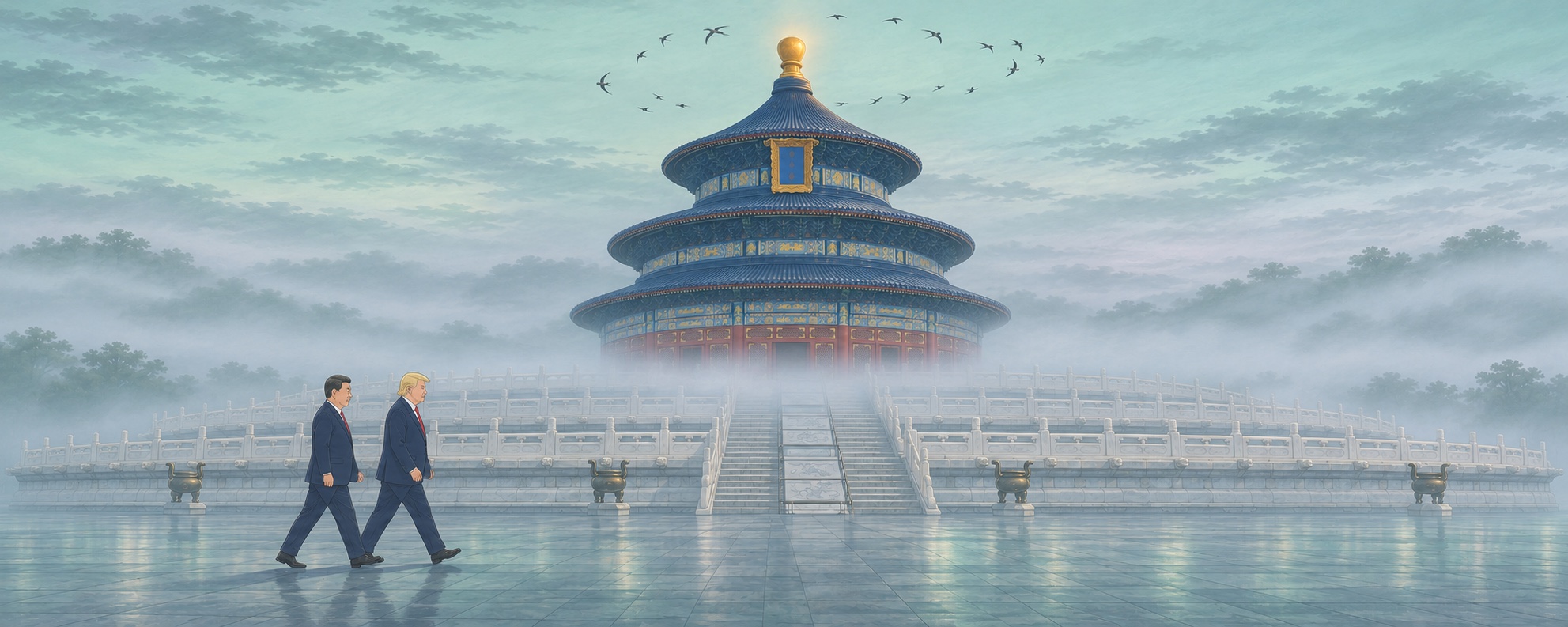
During the Xi-Trump Beijing Summit 2026, President Xi closed the Temple of Heaven for the visit. It's far less known in the West than the Forbidden City, but if you ever go to Beijing, it's a must-visit. Looking at the footage and photographs, I was struck by how stunning it is: the rooflines, the wood sculptures, the detail. I visited as a child, but I don't think I truly saw it then.
I hope Western media takes this moment as an invitation to go deeper, not just into the optics of the visit, but into what the Temple of Heaven actually represents philosophically. Because this is where the conversation about China usually goes wrong. Western commentary tends to call China an atheist nation. Modern China is officially secular, yes. But atheist in its philosophical foundations? Not quite. And on the other side, we have to be honest that America is fundamentally a Christianity-shaped civilization. When you have that difference at the table and you don't understand it, you will keep misreading each other.
Modern China is officially secular, yes. But atheist in its philosophical foundations? Not quite.
So what does the Temple of Heaven represent? It's the physical embodiment of the Mandate of Heaven, Zhi TianMing (知天命) in Chinese. And this concept is profoundly different from the redemption-based structure of most Western religions. In Christianity, and in many other faiths, there's a fundamental premise: you are born sinful, and through faith you earn a chance at redemption. There is a linear arc: a beginning, a fall, a salvation, an apocalypse, a second coming. History moves in a line toward an end.
The Mandate of Heaven works differently. The orthodox Chinese philosophical view is that your destiny is already woven into the fabric of the universe. There is no original sin to overcome, no redemption to be earned. And crucially, there is no apocalypse. No end of the world. Chinese Time is not a line moving toward a conclusion. Chinese Time is a cycle. Dynasties rise and fall. Powers ascend and recede. The wheel turns.
And if you understand that, suddenly a lot of Chinese behavior makes more sense to Western eyes. For example, this is why most Chinese people I know are genuinely not excited about being officially designated G2, number two in the world. And many are equally uncomfortable with the idea of being number one. It's not false modesty. It's a philosophical disposition rooted in cyclical thinking: being at the top means you are closest to the moment of decline. There are enormous costs to maintaining that position. Standing out is a cautionary tale, and caution is wisdom.
So when you hear analysts ask why China isn't more aggressive about claiming global dominance, the Mandate of Heaven is part of the answer. Chinese people are not living toward a finale. They believe life is about managing the cycle.